Helping a Horse Settle in a New Home - the 3-3-3 rule
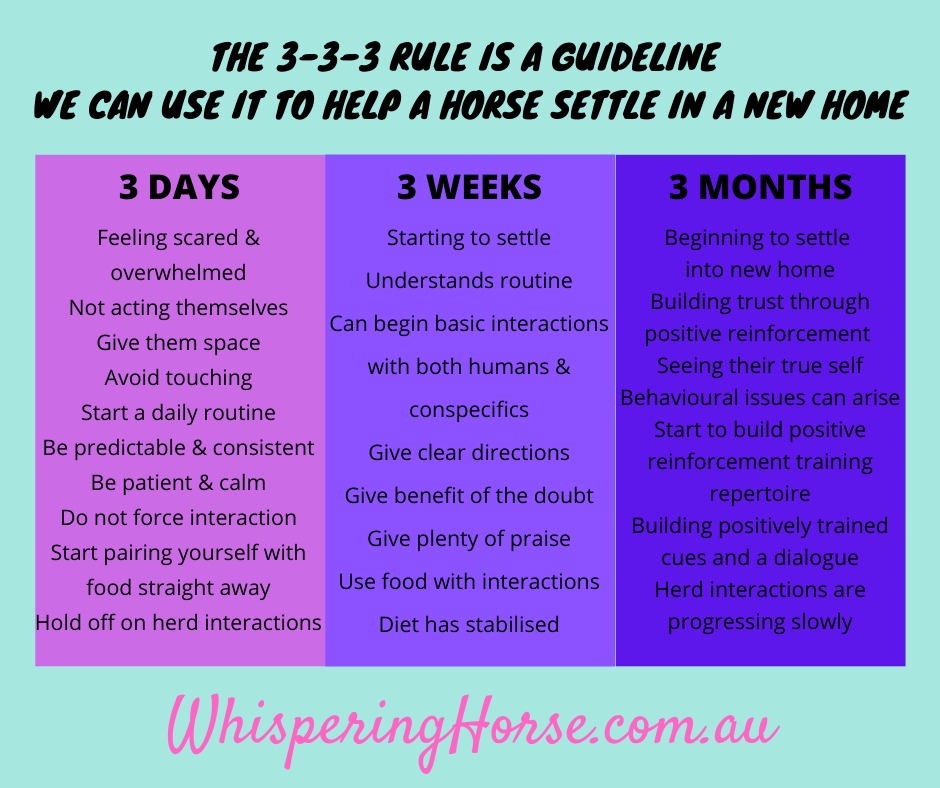
There is a 3-3-3 rule that applies to rescue dogs and I thought that we need something similar for horses.
Obviously the ideal would be that horses are not continually changing homes, but the reality is very different.
Therefore I feel that it needs to be acknowledged and recognised what a traumatic experience moving homes is for horses, so that we can make the best out of a bad situation for the horse.
The source of this concept is from Dr Patricia McConnell and Dr Karen London, in their book, Love Has No Age Limit, Welcoming an Adopted Dog into Your Home.
I love this idea for dogs and I feel this can equally be applied to equines and many other pets and animals. It’s most definitely meant to be a guide, not a rule and needs to be adjusted accordingly for the individual. Often it can take a lot longer than this.
When a horse changes homes, it’s important to remember that this will be one of the most stressful events in their life. Just as it is recognised that moving is one of the most stressful things a human can experience, it is even more so for our horses.
This is because they have no warning, no preparation, no choice, it happens suddenly and worse, usually everything that is familiar to them is gone forever.
This can be completely de-stabilising, disorienting and quite frightening. It’s amazing most horses handle it as well as they do.
Imagine:
A complete change in diet, everything from the grass you eat, the taste and smell of the water, the hay and hard feed are different, the containers you eat out of look and smell different and what if you now had to protect your food from being taken away or stolen by other horses or animals. Imagine then experiencing digestive upset, cramps or you have trouble eating the food or drinking the water, because it’s so different from what you are used to.
What if you came from a small handkerchief sized paddock with just dirt and were thrown into a vast expanse of grass and trees and water and hills, or vice versa. It could be so overwhelming. What if you lived in a herd with plenty of room to run with friends and was then moved to life in a stable or stall.
Everything would look, sound and smell different, the wind, birds and other animals, machinery, traffic and even surrounding human sounds.
What if there were obstacles in the paddock you’d never encountered before, what if you hurt yourself because your proprioception was poor because of where you used to live.
Imagine leaving all your friends behind, forever. You probably don’t know what a family is, having a mother and father or siblings or aunties and uncles, a real herd. This is because you were suddenly removed (weaned) from your mother and lived your whole life with strange horses and tried to get along as best you could. Some of them acted quite strangely, were over friendly, or aggressive, some were calm and some were fun, so you got by the best you were able.
Imagine starting afresh where you don’t know anyone and they don’t know you, and you were desperately missing all that you left behind.
What if you happily lived in a big herd of friendly horses and then found yourself all alone, not even another (strange) horse in sight.
What if you’d resigned yourself to living alone, was pretty depressed about it, but got food and water regularly and were then thrown into a herd of completely strange horses. A herd who all knew each other and had their friends and knew where they fit and didn’t particularly appreciate you being thrown in the middle of their settled and organised herd. They chased you away, didn’t let you rest, or make friends, or eat food or drink and you were an outcast because you were a stranger.
Then there is this strange human who wants to interact with you, touch you, brush you, put gear on you and ride you.
How very unsettling and scary would that be, especially when they seem to speak a completely different language with their bodies and their gear, compared to the previous human you had known.
They smell different, act different and all their communication is like another language. You have to learn a whole new way to interact with these foreign creatures who control your whole life.
Imagine it for a moment, what we do to horses and what we expect from them. We want to ride them the first or second day and wonder why they’re not the same horse.
That’s an awful lot to expect.
But we can try to make it better.
Take it slowly, keep your expectations low. 🧡