
Training other species is such a valuable learning experience. I consider myself a multi-species trainer and I love to train different animals whenever I can. But lately it’s been mainly equines and it’s so good to experience challenging training situations, where the animal you are training reacts very differently to what you are used to. It really stretches you to abandon habits and try new things.
Some of the standouts for me from the workshop was each chicken’s incredible ability to recover from a fright after only one repetition. If I moved my hand too quickly towards them with the food bowl or accidentally reached over the top of them, they would get a fright. But if I then did that exact movement again, they didn’t respond in fright the next time. It was quite fascinating. Our host Rebecca Faulkner jokingly called it “accidental resilience training” and I liked that. The acronym was “ART” and it reminded me of how complex and fascinating the art and science of animal training is.
I recall thinking whether this “ART” was an example of one trial learning, but I don’t think that’s exactly what’s happening. If anyone knows what this is called, I would love to hear about it.
What was also fascinating was that each chicken was an individual and responded differently. From one chicken that took off and literally flew/ran back to the coop as soon as the door to their crate opened, to the rooster I trained. He started out shy and quiet and when I got to train him, he had started to feel more comfortable and became extremely vocal, crowing to the hens around him who were all cooing and clucking. He would flap, ruffle his feathers, crow loudly and yet still engage with me and learn at the same time. It was quite a thrill to have a rooster literally crowing in my face and the next moment offering behaviour and accepting food from me in return.
We discussed their ethogram. As prey animals, they are extremely aware of their environment, especially above them, movement, shadows (potential predators, us, other birds, etc) and would sometimes respond to their environment, but quickly bring their attention back to us.
Did I say they are fast?! They are very fast moving, fast thinking, fast learners and they figure things out super fast and are very brave at offering behaviour.
I’m so used to equines who can take weeks to learn the association of the clicker = food and yet here we were with chickens who had never heard a clicker before and yet it seemed to have meaning to them very quickly. I kept having a conversation in my head; “do they really know what the clicker is? Or is it just our movements, or is it contiguity? Based on their behaviour, I would think it’s helping them, but how can that be? I would love to test it!”
It was easy to start behaviour using both their curiosity and a bit of luring or food placement or feeding for position, but it often switched very quickly to them offering behaviour based on the flow and placement of reinforcement.
Some of the other participants did discrimination training, either shape or colour and it was picked up extremely quickly in one session. It was so fascinating to watch.
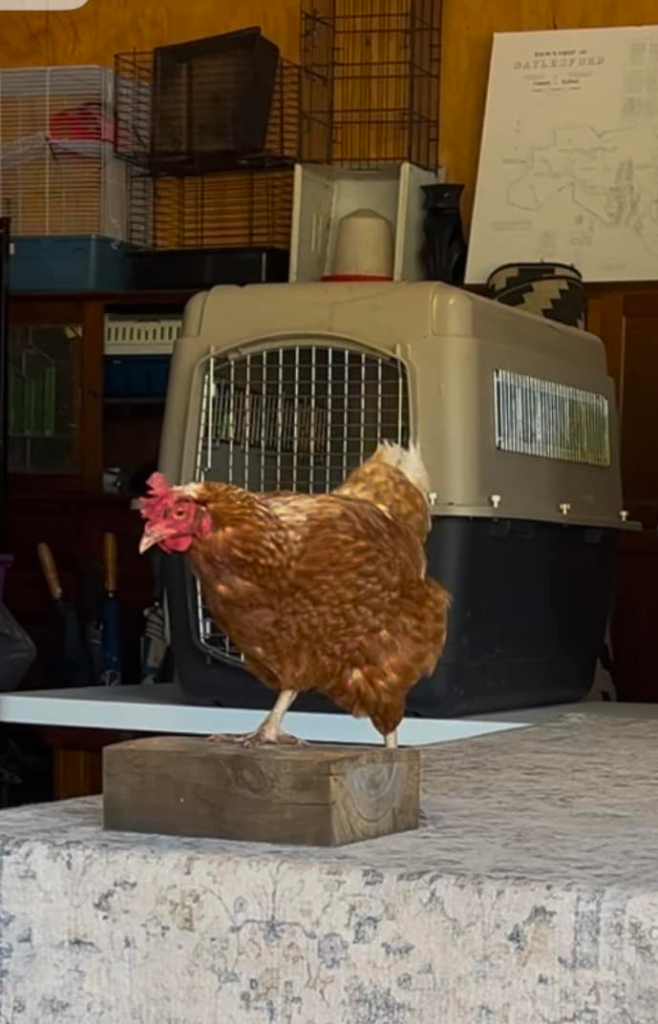
I also noticed how observant the chickens were. They would notice colours, for example I tried a target stick and the handle was the same colour as the food container I was using, so my chicken kept orienting to the handle of the clicker, even when I tried to cover it with my hand. They also watch our movements very closely, especially our hands because our hands deliver the food. But they were also quick to realise if the food container was in a certain position or we closed the opening, that reinforcement was not available and they would offer some other behaviour.
The chickens were also very creative and fluid in their behaviour. Sometimes we just had to laugh at how clever and creative they were and how much they surprised us in what they offered or what they figured out.
Something else that was really interesting when comparing equines to the chicken learners was the luring and the lumping. I tend to actively avoid doing these things with equines, as they have such a strong and emotional connection with food and also because many equines have a lot of trauma and anxiety around food.
Whereas these lovely chickens were extremely optimistic in regards to learning and food acquisition. There was an interesting mix of trainers at the workshop and the more inexperienced trainers tended to “lump” a little, but the chickens were often totally cool with this. So I guess I can’t even call it “lumping”! It was a good lesson for me to reflect on how I approach my training and these kinds of workshops are super valuable for teaching us to be more flexible in our training approach.
I think perhaps because I train a lot of fearful equines, I’m overly cautious about wanting to make the experience super positive, in order to get the counter conditioning effect. But problem solving is empowering too. I do notice I can do things differently with a lot more with fearful equines than I can with more optimistic learners.
I’ve been given permission to share video, as all the sessions were filmed by Rebecca, our host. It was hard to choose, but I liked this one, as it was on the first day and I was still figuring things out and there is some interesting progression and observations.
The Rhode Island Reds were very different to some of the other breeds we trained, who were a little more cautious and timid at the start. But they all did fantastic by the end, even the funny little hen who flew off. She came back quite quickly and settled in a crate and joined the training.
If you’re in Australia, there are more workshops planned and I highly recommend doing one and no experience needed. Anyone is welcome and I had the best time with a lovely group of people. Rebecca Falkner did an amazing job at balancing just the right amount of advice and support and letting us experiment and learn as we went.
This is her website, she trains animals for movies and commercials, isn’t that amazing!? There are details and future dates for workshops listed: